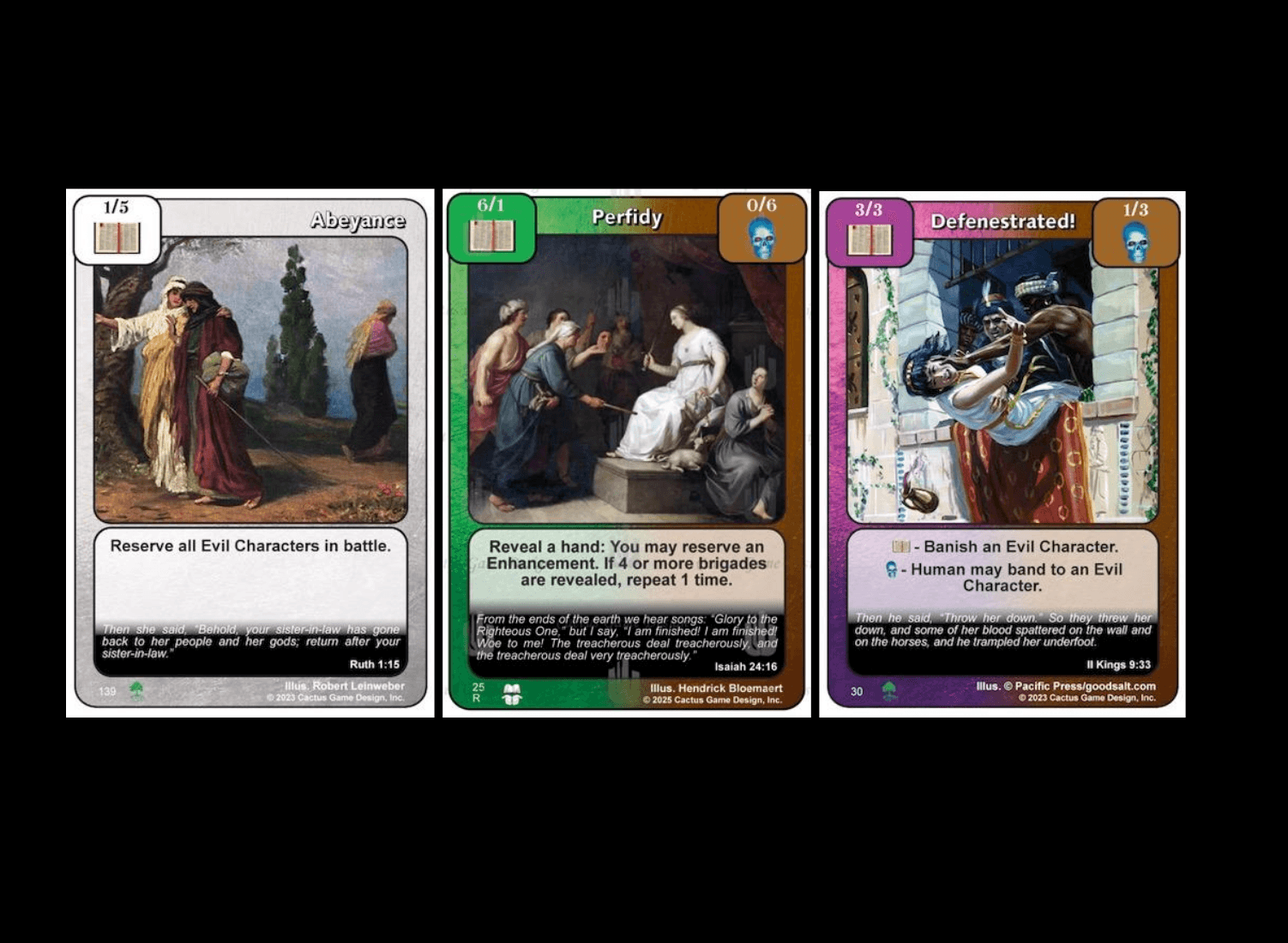
Perhaps you have torn a copy of Haman’s Plot, or even several copies. But have you ever felt the urge to throw a card out of a window? If the design team had used one of their more wild ideas, you might have been required to do just that.
Welcome to the Mirror of Galadriel, a series in which we explore things that were, things that are, and things that yet may be.
Last time we discussed the dogs that eat the crumbs that fall from their masters’ table. I then teased that we would discuss a very different kind of dog food this week. That food is Queen Jezebel.
Things That Were: Defenestrated!
I have heard Jezebel referred to as “the dog food queen.” This appellation, though macabre, is apropos considering the grisly demise of that iniquitous despot.
If you’re wondering why I just inserted some fancy words, it’s because one of the most memorable Jezebel-related Redemption cards is also Redemption’s best example of teaching a fun vocabulary word. That card is, of course, Defenestrated!

The definition of fenestration is “the design and placement of windows in a building.” Add the prefix de- and you get defenestration, “the act of throwing someone or something out of a window.” It’s a wonderfully specific word, made even more fun by the addition of an exclamation point.
My dad named the original version of the card. He actually learned the word from a comic book. In G.I.Joe #121, a ninja is defenestrated from a castle. That castle would later transform, causing Megatron to mistake it for a fellow Decepticon. Comics are weird.

Anyway, Defenstrated! was briefly suggested to be a powerful card with a cost similar to the original Haman’s Plot. Rather than tear the card in half, you would have to throw it out the nearest window. I think most everyone can agree that that would have been problematic. I don’t remember whether the suggestion was 100% a joke, but I’m sure it was never seriously considered. It was more like the sort of wild idea that is brought up in a brainstorming session and then inevitably rejected.
As you can see from the version that was eventually printed, the card’s ability was nothing extraordinary. However, it is significant to the history of Redemption for another reason: it is among the earliest dual-aligned enhancements. (Note: the Philosophy promo was released several years earlier, but that was a meek card that was originally intended as a one-off gimmick, very different from the FooF and RoA tin cards that normalized the concept.)
Some of these earliest dual enhancements were made so because they were an amoral object (like Foreign Sword) or something that blessed everyone, both good and bad (like Seven Years of Plenty). However, Defenestrated! was made dual for a different reason. Like the dual Isaiah and Ezekiel cards, Defenestrated! was made so because it is an example of God accomplishing a good thing through evil characters.


These prophecy enhancements described how God used the evil empires of Assyria and Babylon to bring judgement and correction to Israel and Judah. If that seems strange or unjust to you, or if it’s something you’d like to learn more about, I recommend reading the book of Habakkuk. The prophet Habakkuk actually complained to God for using the wicked nation of Babylon to punish his people. God’s response is fascinating.
The story of Defenestrated! is similar. Jezebel was killed by followers of King Jehu, who was not a very righteous ruler himself (although he was better than Jezebel and Ahab). Jehu was an idolater, but he was obedient enough to end the tyranny of Jezebel.
The best thing that Redemption can teach players is Scripture. But it’s also great when players learn some new words along the way. Perhaps you didn’t know what abeyance means. And I’ll admit I had to look up the definition of perfidy after that card was spoiled for the new set. But to me, Defenestrated! is still the most fun title ever given to a Redemption card.


Defenestrated! was reprinted for rotation in the Roots set, along with most of the other dual enhancements in this article. However, Jezebel herself still has no rotation legal card, nor does her husband Ahab. They were both first printed in the original Redemption set, but since then have only been given fresh versions in Rock of Ages. It is especially surprising to me that Jezebel has not been reprinted in so many years. She is a very iconic biblical figure. In fact, I can’t think of anyone more infamous who hasn’t received a rotation version yet.


The Rock of Ages version of Jezebel was not particularly useful on her own, except against green heroes (which is an appropriate exception considering her persecution of the prophets). However, she enabled King Ahab’s play ability, which was quite powerful – especially because Haman’s Plot is a brown O.T. enhancement. I imagine it is only a matter of time before these two are given new versions. The evil royalty of Israel theme is almost non-existent in rotation, so there’s a great opportunity to redefine it with fresh abilities and strategies.
Things That Are: Dual Enhancements
In many ways, the dual enhancements of today are similar to the originals from the scroll days. However, there are at least two notable changes. One change is that the good and evil halves sometimes have different numbers and special abilities than each other. Another notable change is that they are much more numerous. There were only ever 9 dual enhancements printed in the scrolls format, whereas there are currently 82 dual enhancements in rotation. Almost every rotation set has multiple, even the most recent starter decks. There are 22 in the Fall of Man set alone.
Dual enhancements are now plentiful, but are they worth including in your decks? Let’s look at the pros and cons of dual enhancements.
First the pros:
- Flexibility of Use: The most obvious benefit of dual enhancements is that they can be used by either your offense or your defense, assuming that the brigades match. This is helpful, because you can use it whichever way you need in each game.
- Easier Targeting: Another benefit of dual enhancements is that there are almost twice as many cards in the game that can search for them. Even if you plan to use a dual enhancement as good, you can target it as evil (and vice versa). For example, imagine you are building a Daniel deck. You decide to splash in The Woman of Thebez as a chump blocker. If you include Return to Fight in your reserve, then you can use her take ability to grab that enhancement for your offense.


This is the reason that I often move Abandoned (or Evade) to my reserve when I play Sealed Deck. In my experience, it’s not unusual to have an opportunity to attack with a hero like Abiathar when I already have plenty of good enhancements, and I would rather take an evil card. Similarly, in some games I block with characters like The Murdering Pharaoh so many times that I run out of evil cards to take, and I wish I could grab something for my offense. Having dual aligned cards like Abandoned in my reserve helps mitigate these problems, allowing my offense to help my defense, and vice versa.


- Booster Draft Noncommittal: When drafting, it is often wise to choose a dual enhancement over a regular one, especially early on before you establish which brigades you are trying to collect. You are more likely to be able to use a dual enhancement, and taking it won’t pressure you into drafting characters of one specific brigade. For instance, if you draft Defenestrated! from Roots, then it’s OK if you don’t end up drafting any purple heroes, because your brown evil characters can use it.
- Type 2 Alignment Imbalance: In Type 2 decks and reserves, you must have an equal number of good cards as evil cards. This generally prevents players from building offense-heavy or defense-heavy decks. In my opinion, the most restrictive aspect of this is the reserve, because many offenses and defenses do not have an equal need to take cards from reserve. If most of your ways to take cards from reserve only take good ones, then half of your reserve will be wasted. However, dual-aligned cards are a way around this, because they are considered neutral for deckbuilding. For example, if you want more than half of your reserve to be good enhancements, then you can include dual enhancements that work with your offense, reducing the number of slots that have to be filled with evil cards.
Now the cons:
- Weaker Effects: The tradeoff for the increased flexibility is that dual enhancements tend to have slightly weaker special abilities than similar single-alignment cards. There are plenty of exceptions, so of course you can judge each card on its own merits. But overall, you will find that many dual enhancements aren’t worth including in a competitive deck unless they can be used effectively by both your heroes and your evil characters.
- Vulnerability to Targeting: I mentioned that the fact that dual enhancements are easier to target is a benefit, but it can also be a weakness. After all, these cards are easier for opponents to target, too. For example, if you are running Snatched Spear for your purple warriors, opponent can discard it from your deck with Gabriel, Sent by God even though you were never planning to use the spear as evil.


- Brigade Bloat: In a game with cards like Matthew the Publican and Queen Tahpenes, having extra brigades on your cards is a significant liability. If one or more brigades on a card are not useful for your deck, then those brigades are a negative, not a positive. Let’s use Snatched Spear as an example again: it’s a great card for purple warriors, but if you don’t already have pale green in your hand, then it’s adding an unnecessary brigade to your total.
Things That Yet May Be: The Canaanite Mother
Last week, I challenged readers to design a card of the Canaanite mother from Matthew 15. Thank you to the three clever individuals who submitted their creations. What’s particularly cool about these designs is that even though all three are creative and thematic, they are also very unique. They each have a different title, ability, piece of art, and even brigade.
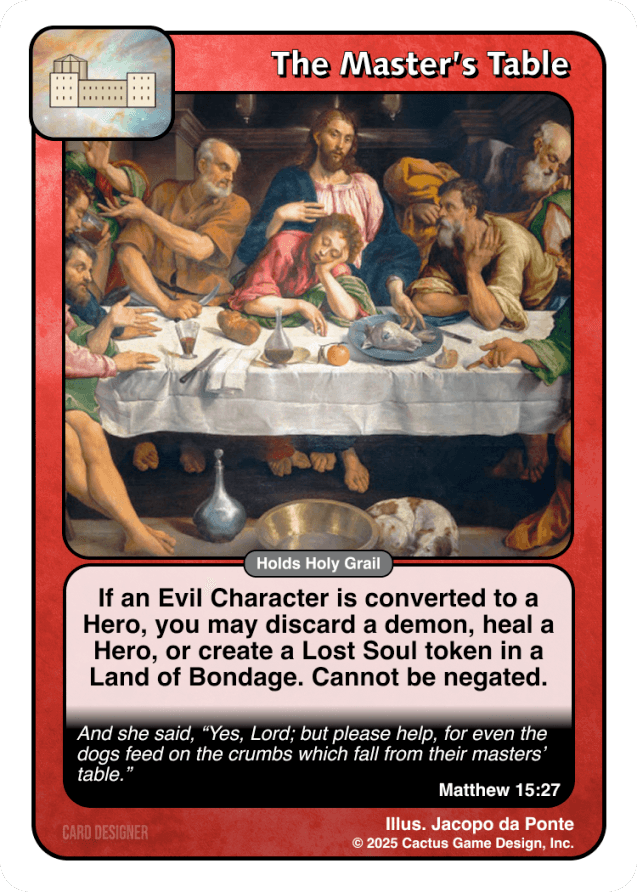
Editor's Note: here's Master's Table from last week for a reminder:
The first submitted is BaboonyTim’s The Woman of Canaan:

I like how Tim made her work well with Great Faith (because she is purple hero who gets initiative) and with The Master’s Table (due to her convert ability). But the best part of the design is how he captured the theme of her persistence. The first time she asked for help, Jesus didn’t answer. But she kept asking, and Jesus showed compassion by performing a miracle. Tim’s design represents this by having her ability not work the first time she uses it. Very clever! Because her ability only works once, she is not overly strong, but at least she is always useful for getting initiative.
The second submission is Tyler Steven’s The Devoted Mother:

It’s no surprise that Tyler would come up with a great idea, as we enjoy his designs every time we play. Retrieving Gospel enhancements from discard pile is a perfect way to represent the theme of the fallen crumbs. The idea of putting an evil card on the bottom and a good card on top represents the mother’s great humility, as she recognized Jesus as master over us. The option to paralyze a demon is also a nice effect with obvious theme. Put it all together, and you have a hero that is thematic and useful without being overpowered.
Finally, there is Brandon Barker’s The Faithful Canaanite:

I like that she can search for The Master’s Table, but it’s especially cool that she can search for any good enhancement, as that is the classic ability of Great Faith. Being able to take from opponent’s deck makes this a rare example of a good card that can hurt opponent’s offense; normally I wouldn’t like that so much, but it’s great here because it’s in theme with the idea of asking for blessings that in some sense belong to another people. It also helps Gospel gold’s efforts to make opponent deck out. Of course the additional ability of discarding a demon is thematic as well. Altogether this card is very strong, especially with the “regardless of protection” modifier.
Thanks again to all who submitted a card!
Card Creation Prompt
For this week’s custom design, I’m challenging you to create a card for a different Canaanite mother. You are to design a rotation version of Jezebel. (Yes, Jezebel was both a Canaanite and a mother. And dog food, don’t forget.) In my opinion, Jezebel ought to be a very powerful card. If any evil characters push the boundaries of power level, I think they should be iconic ones like Cain, Pharaoh, Goliath, Jezebel, and Judas. Besides, the evil royalty of Israel theme could really use some support. If you would also like to create and submit a version of King Ahab to pair with your Jezebel, feel free, but it is certainly not a requirement.
For reference, here are some rotation enhancements that should be usable by Jezebel:


I
f you create a Jezebel and/or Ahab, please be sure to send them to me (Ear-A-Corn on Discord) before the end of Friday, 8/29.
I hope you found this installment interesting. Next time we will discuss a certain female hero from the scroll days who has never been reprinted. I doubt you would guess her name in 100 tries…
(Editor's Guess: Widow)
To buy singles, sealed product, and other gaming supplies mentioned, please visit our sponsors!